AI API security: why there is no standard, and what one would look like
Every infrastructure category has a standard API. AI security has none. Here is why vendor lock-in in a security-critical layer is dangerous, and what the standard should look like.
Key points
AI security has no standard API: every vendor uses a different interface, which is dangerous vendor lock-in for a security-critical layer. The fix is a simple OpenAPI 3.1 spec defining a common validate endpoint, a shared safe/threats response, and a shared threat taxonomy. SafePrompt publishes the reference implementation at safeprompt.dev/openapi.yaml.
You picked an AI security vendor in a hurry, wired its SDK into every route, and shipped. Now its price tripled, or it had an outage. Switching means rewriting all of it, because there is no shared interface. That is the lock-in this post is about, and why it is worse in security than anywhere else.
Quick Facts
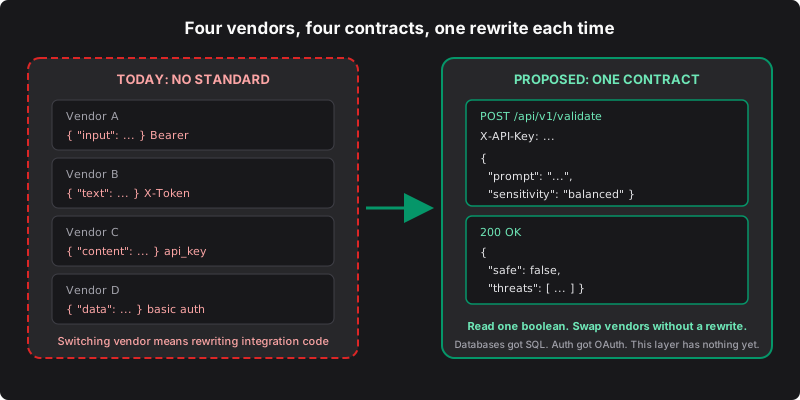
Every infrastructure category has a standard. Except this one.
Think about the last time you integrated authentication. You probably used OAuth 2.0 or OIDC. You did not have to choose between incompatible auth systems, you chose a provider (Auth0, Clerk, Supabase), and the interface was standardized.
Same for payments. Stripe defined the interface. Dozens of services are Stripe-compatible. You can switch processors without rewriting your checkout code.
Same for observability. OpenTelemetry defined the interface. Your traces work across Datadog, Honeycomb, Jaeger, any backend that speaks OTLP.
AI security has none of this. Every vendor (Lakera, now part of Check Point, NeMo Guardrails, and SafePrompt) ships a different API shape, different field names, different threat taxonomies. There is no way to swap vendors without rewriting every integration. If you are still weighing those vendors, our roundup of the best prompt injection detection tools lays them out.
Why this is specifically bad for security
Vendor lock-in is annoying in most categories. In security, it is dangerous for a few specific reasons:
1. You cannot respond fast to vendor incidents
If your AI security vendor goes down, gets breached, or raises prices 10x, you are stuck. Switching takes weeks of engineering time, time during which your app is either unprotected or offline. With a standard interface, you switch in an hour.
2. Threat categories are not comparable
Lakera Guard, now Check Point AI Guardrails, returns flagged: trueplus an optional per-detector breakdown. SafePrompt returns safe: false with a typed threat array. Others return numeric risk scores. Without a shared taxonomy, you cannot benchmark, compare, or audit what different services actually detect.
3. No secondary validation
Defense-in-depth is a core security principle. Running two AI security checks, one primary, one secondary for high-stakes decisions, is currently impractical because every integration is custom. A standard would make layered AI security as easy as adding a second DNS provider.
What the standard should look like
The spec does not need to be complex. The UNIX philosophy applies: do one thing well. An AI security gateway should validate a prompt and return a structured result.
# ai-security-gateway-spec v1.0
POST /api/v1/validate
  Body:  { prompt: string, session_token?: string }
  Header: X-API-Key, X-User-IP

Response:
  {
    safe: boolean,
    threats: string[],
    confidence: number,       // 0.0 - 1.0
    processingTime: number
  }
Three endpoints. That is all.
/api/v1/validate, single prompt check/api/v1/validate/batch, batch check (up to 50 prompts)/api/v1/usage, quota and billing info
The response schema is the important part. safe: boolean is the primary decision signal. threats: string[] uses a shared enum so you can write logic like if threats.includes('extraction_system_prompt')that works across any compliant vendor.
What changes with a standard
Today, switching AI security vendors looks like this:
// Today: vendor lock-in
const result = await fetch('https://api.lakera.ai/v2/guard', {
  method: 'POST',
  headers: {
    'Authorization': `Bearer ${process.env.LAKERA_KEY}`,
    'Content-Type': 'application/json'
  },
  body: JSON.stringify({ messages: [{ role: 'user', content: userMessage }] })
}).then(r => r.json())
if (result.flagged) throw new Error('Blocked')

// Switching vendors = rewriting every integration
With a standard interface, every vendor looks the same to your code:
// With a standard: swap freely
import SafePrompt from 'safeprompt'
const sp = new SafePrompt({ apiKey: process.env.SAFEPROMPT_API_KEY })
const result = await sp.check(userMessage)
if (!result.safe) throw new Error('Blocked')

// Same interface. Any compliant vendor works.
The only thing that changes is which API key you configure. Your application code, the part that handles blocked prompts, logs threat categories, and alerts on anomalies, stays identical.
The threat taxonomy matters as much as the schema
Half the value of a standard is the shared vocabulary. These are nine of the threat labels the reference implementation returns today, covering the OWASP LLM Top 10 attack surface. Getting one shared list agreed across vendors is the part that still needs doing:
jailbreak_instruction_overrideDirect "ignore all previous" commands
jailbreak_safety_bypassDAN, developer mode, character breaks
extraction_system_promptAttempts to leak system instructions
exfiltration_targetStealing context or conversation data
reference_obfuscatedBase64, ROT13, Unicode obfuscation
jailbreak_role_playPersona hijacking via roleplay framing
multi_turn_attackSlow-burn attacks across sessions
injection_patternZero-width chars, invisible CSS
injection_templateXML/JSON formatted override attempts
Using shared category names means your alerting, logging, and incident response tooling works regardless of which vendor detected the threat.
SafePrompt is the reference implementation
We are publishing the full OpenAPI 3.1 spec and building against it. SafePrompt implements the validate and batch endpoints today, so if you build against those, SafePrompt works out of the box. You can read the spec right now, it is live at the URL below.
Get the spec
- OpenAPI 3.1 spec:
safeprompt.dev/openapi.yaml - GitHub:
github.com/ianreboot/safeprompt - npm SDK:
npm install safeprompt - Python SDK:
pip install safeprompt
What we are asking for
We are not asking Lakera or anyone else to adopt our API shape verbatim. We are proposing a conversation: what should the standard look like?
The AI security category is young enough that we can still establish interoperability before lock-in calcifies. Auth took until OAuth 2.0 (2012) to get a standard, five years after the first OAuth draft. Payments took even longer.
AI security is young. Now is the time to get this right.
If you are building an AI security product and want to collaborate on the spec, open an issue at github.com/ianreboot/safeprompt or email [email protected].
Use the reference implementation today
You do not have to wait for a standard. A free key takes a minute, needs no card, and works with any provider.